This article is about What are Actuators, its principle and applicationsand focusing to the engineers, technicians and supervisors. You will find lot of documents related to this article. Just navigate our website www.paktechpoint.com and find more articles. Please! Do not forget to subscribe our You tube channel also. Thanks in Advance.


What are Actuators, its principle and applications
Introduction
- Agent
- Agent Requirements
- Introduction to Actuators
- Actuator Components
- Actuator Types
- Actuator Applications
- Conclusion
- Links & References
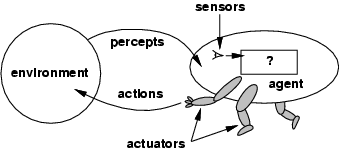
An Agent
- Perceives environment
- Think for the results through their intelligence
- Perform actions as a result
Types
- Human
- Robot
- Software
Intelligent Agent
An robot agent which works with its actuators and apparently, it works via sensors in environment.
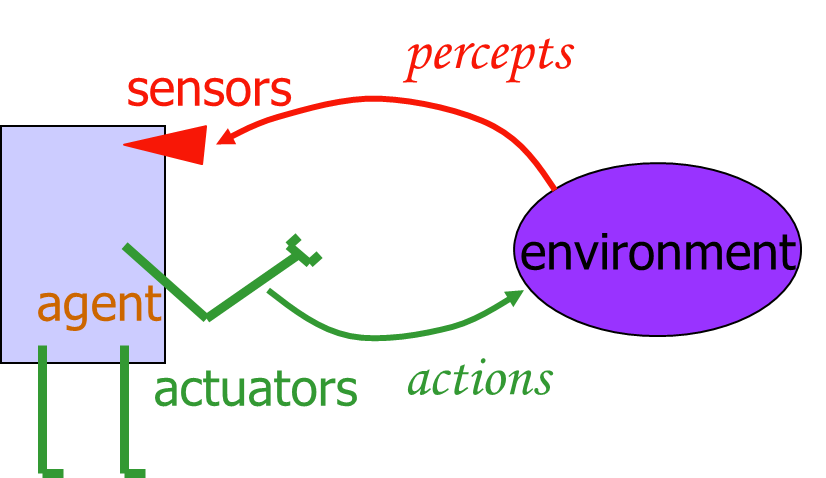
Agent Environment
Before we design an intelligent agent, we must specify its “task environment”:
- Performance measure
- Environment
- Actuators
- Sensors
Actuator stands for
A= Allowing
C= Component
T= To
U= Undergo
A= Action
T= To
O= Offer
R= Response
One that activates, a device responsible for actuating a mechanical device.
An actuator is the mechanism by which an agent acts as a result of any change perceived in the environment. The agent can be either an artificial intelligence agent or any other autonomous being (human, other animal, etc.
Actuators may be grouped in a number of ways:
- Electromechanical
-
- Electromagnetic
- Electrodynamics
-
- Fluid mechanical
-
- Pneumatic
- Hydraulic
-
- Thermal
Electric Actuators
It uses ELECTRICAL energy for the activation function It may result in
-
- Rotation
- Linear movement
- linear movement with gear or with real linear motor
Main Features
- Easy to control
- From mW to MW
Main Features
- Normally high velocities 1000 – 10000 rpm
- Several types
- Accurate servo control
- Ideal torque for driving
- Excellent efficiency
- Autonomous power system difficult
Principal of Operation
An electric current in a presence of magnetic field produces a force F= I L X B . . . (1)

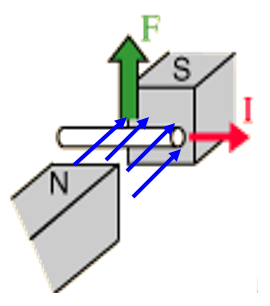
We make current carrying wire in form of loop, you can see two sides of loop perpendicular to the magnetic field and will experience forces with opposite direction
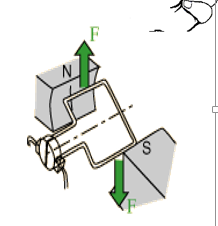
The pair of forces produce a turning effect or torque to move or rotate the coil
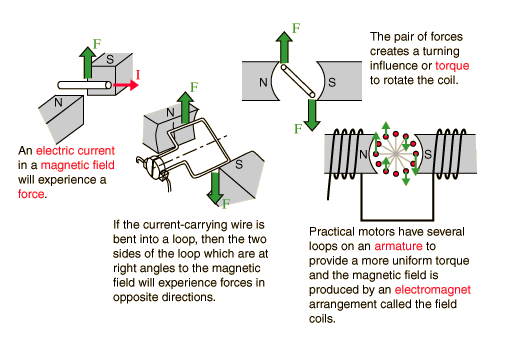
- to produce a more uniform to torque, in pratical motor we should have more loops.
- Electromagnets produce magnetic field and are called field coils
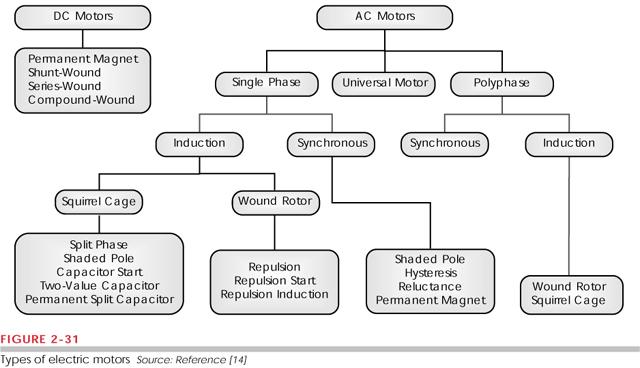
Types of Motors
Following are some types of Motors:-
AC Motors
DC Motors
- Modified from Basic AC DC Motors
- Torque Motors
- Servomotors
- Stepper Motors
- Brushless Motors
- Linear Motors
Hydraulic Actuators
- It uses HYDRAULIC head (of water) for the actuation function
- Main Components
- Motor & pump actuator combination
- Motor, generator, battery
- Motor & gear combination
- Main Features
- Linear movement
- Larger forces without gears
Main Features
-
- Actuators are simple
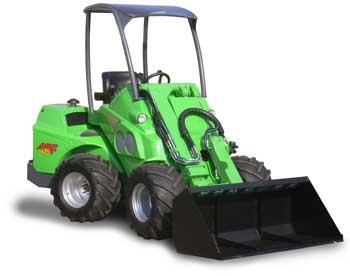
- In mobile machines
- Bad efficiency
- Many times larger load can be manipulated
Medium used
-
- Oil
- oil/water mix (non flammable)
- water + corrosion inhibitors
– virtually incompressible
– viscosity heavily temperature dependent
Pressure Range
- Up to about 30 MPa – 200 MPa for diesel injectors
Applications
- Positioning with high load rigidity precision in closed loop control systems
Hydraulic Systems

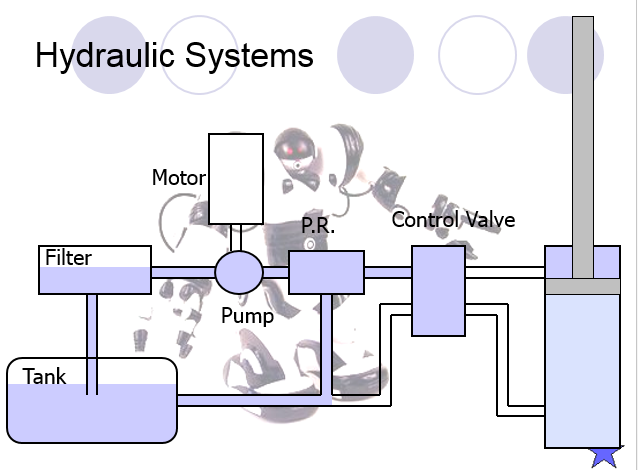

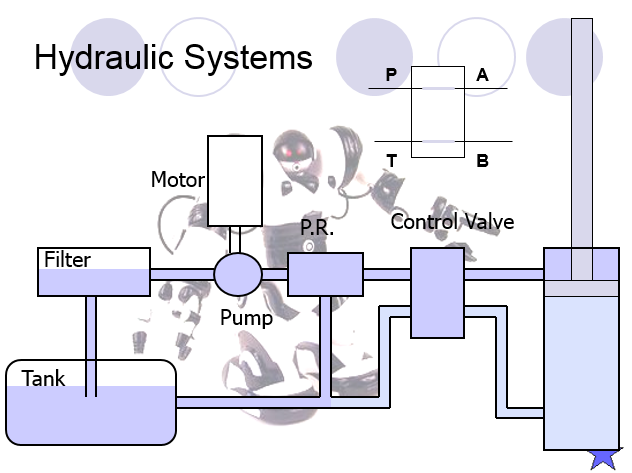
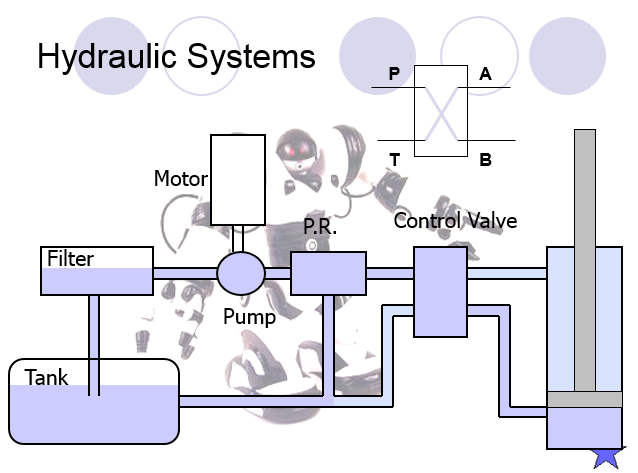
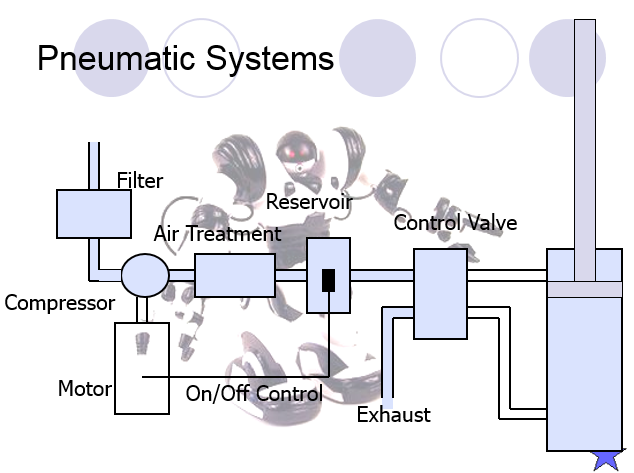
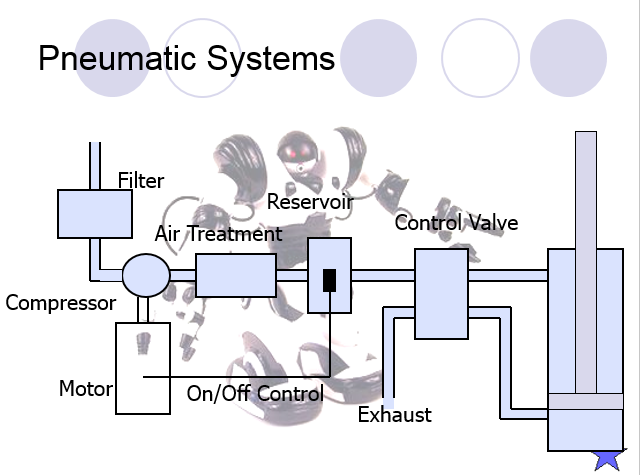
Pneumatic Actuators
- Main Features
- Quick response
- Large forces with elasticity
- No leak problems
- Medium used
- Usually air
– compressible
– separate lubrication probably required.
– viscosity fluctuations not important
Pressure Range
- Up to about 1 MPa
- Applications
- Lower power and force / torque requirements,
- Positioning by mechanical stops in open loop systems.


Thermal Actuators
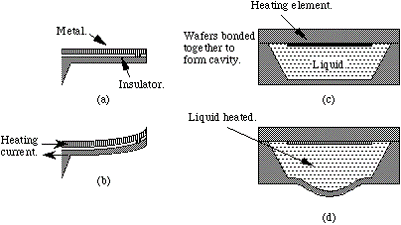
- Working Principal
- Thermal Expansion
- In bimetallic strip
- In thermoloid material
Operation
- When current is applied
- Thermoloid material, sealed in the actuator, changes phase from a solid to a liquid and expands
- The volume of the Thermoloid material the material is essentially incompressible and encased in a rigid housing
- The piston moves and extends
- Motion occurs over a narrow temperature range

- Merits
- precise control of a device at a specific temperature
- operating temperature is extremely stable
- repeatable and accurate
- Applications
- Temperature actuated valves
- Switches & Latches
- Clamps and control devices
- Instrument calibration
Piezoelectric Actuators
A device that cleverly harnesses piezoelectric property and produces movement is called a piezoelectric actuator.
High Power “Hard” Materials
High Sensitivity “Soft” Materials

Merits
Extremely rapid response of 0.01 milliseconds
Ultra-minute movements of 0.01 microns
Amazing power that exceeds 3 kilograms per square millimeter
Demerits
The range of movement they can achieve is extremely limited, on the order of 0.05 millimeters.
Their various characteristics could only be applied to only a limited number of fields.
Application
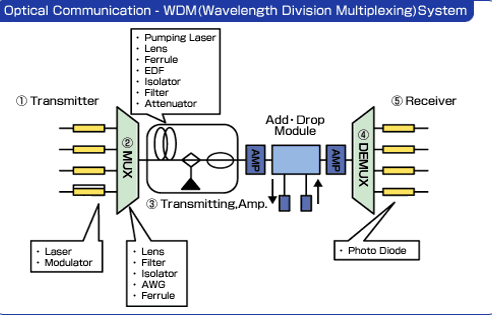
Optical Communications
Applications
-for Motor Vehicles
-for Motor Vehicles
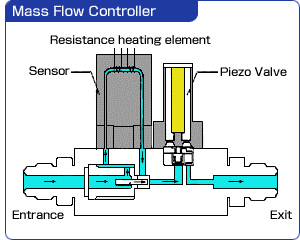
-Mass flow controller
-Semiconductor Equipment
-Medical treatment.