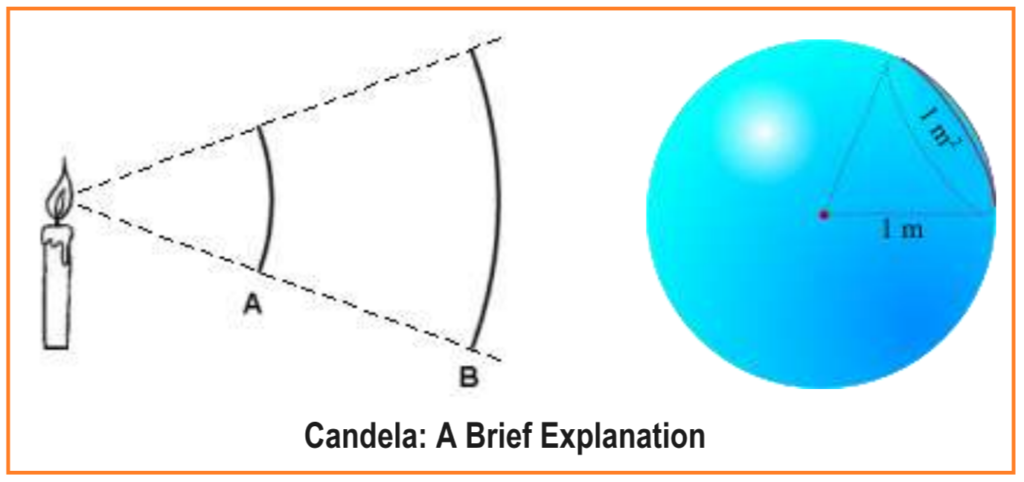
The SI unit of luminous intensity is indeed the candela (cd). One candela is defined as one lumen per steradian, where a steradian is the unit of solid angle. This means that one candela is equal to the luminous intensity emitted by a light source in a particular direction, with a total luminous flux of one lumen distributed uniformly across one steradian.
In simpler terms, the candela measures how bright a light source appears in a specific direction, taking into account both the total amount of light emitted (lumens) and the spread of that light (steradians). It’s a fundamental unit in lighting engineering and is used to specify the brightness of light sources in various applications.
Candela Explanation
The candela (cd) indeed has its origins in the brightness of a “standard candle,” but it has been precisely defined in the International System of Units (SI), and the unit was officially renamed from “candle” to “candela” to avoid confusion and provide a more standardized measurement.
The candela measures the amount of light emitted within a specific three-dimensional angular span. Because luminous intensity is described in terms of an angle, the distance at which you measure this intensity doesn’t matter. This means that regardless of how far away you are from the light source, the candela measures the same amount of light within the specified angular range.
In the illustration provided, both screens A and B would catch the same amount of light rays emitted from the light source if screen A were removed. This is because screen B covers the same angle as screen A, and the candela measures the light intensity within that angular span.
The angular span for the candela is expressed in steradians, which is a measure without a unit (similar to radians for angles in a two-dimensional space). One steradian on a sphere with a radius of one meter corresponds to a surface area of one square meter. A full sphere encompasses 4π steradians. This understanding helps in quantifying and comparing the luminous intensity emitted by different light sources within various angular ranges.
How is the candela different from other units of measurement for light?
The candela specifically measures luminous intensity, which is the amount of visible light emitted per unit of solid angle. Other units like lumens measure total light output, and lux measures light intensity on a surface.
Why do we use the candela as a unit of measurement for light?
The candela provides a standardized way to quantify how bright a light source appears in a particular direction, making it useful for various applications where brightness and visibility are important.
What does it mean when a light source has a higher candela rating?
A higher candela rating indicates that the light source emits more light in a specific direction, making it appear brighter to an observer looking in that direction.
How is the candela measured or calculated?
The candela is measured using specialized equipment that takes into account the intensity of the light emitted by a source and the angular spread of that light. It’s calculated based on the luminous flux emitted within a specific solid angle.
Why is the candela important in lighting design?
Understanding the candela helps lighting designers ensure that light fixtures provide adequate brightness and visibility for their intended applications. It allows them to specify lighting solutions that meet the required standards for safety and functionality.
Can you give an example of how the candela is used in everyday life?
Sure! The candela is used in applications like automotive headlights, where regulations dictate minimum luminous intensity requirements to ensure sufficient visibility for drivers at night.
Does the distance from the light source affect the candela rating?
No, the candela rating remains constant regardless of distance because it measures the brightness of the light source as perceived from a specific direction, independent of the observer’s distance.
How does the candela relate to other units like lumens and lux?
While the candela measures luminous intensity, lumens measure total light output, and lux measures light intensity on a surface. They are related but measure different aspects of light.