Carrier Aggregation (CA) is one of the most important technologies in LTE-Advanced. It was first introduced in 3GPP Release 10, and the first commercial networks using CA were launched in Korea in 2013. CA quickly became popular because it significantly improves network performance. It also helps operators make better use of their existing spectrum, allowing them to offer higher data rates without needing completely new frequency bands.
With Carrier Aggregation, the network can combine two or more LTE carriers (frequency blocks) so that devices can use them at the same time. This increases both peak data rates and everyday user speeds. It also improves downlink coverage and makes it easier for operators to manage traffic across multiple frequency bands.
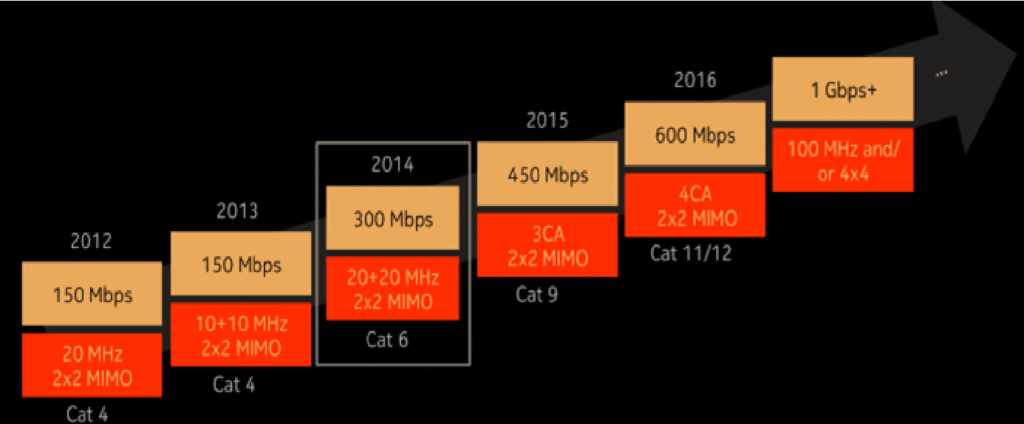
Early LTE networks supported Category 3 and Category 4 devices, which could reach speeds of about 100–150 Mbps using a single 20 MHz carrier. In 2013, the first version of CA allowed speeds of 150 Mbps using 10 MHz + 10 MHz. Later, Category 6 devices introduced in 2014 supported 300 Mbps with 20 MHz + 20 MHz. Category 9 devices increased speeds to 450 Mbps by using 60 MHz in total, and future improvements are expected to reach 1 Gbps.
CA is especially useful when an operator’s spectrum is split into multiple small blocks. For example, combining three carriers such as 10 MHz + 10 MHz + 20 MHz allows a network to deliver 300 Mbps even when spectrum is fragmented. This paper examines the practical performance of CA, the optimization needed to improve its operation, and how the technology will continue to evolve.
Carrier Aggregation in Live Networks
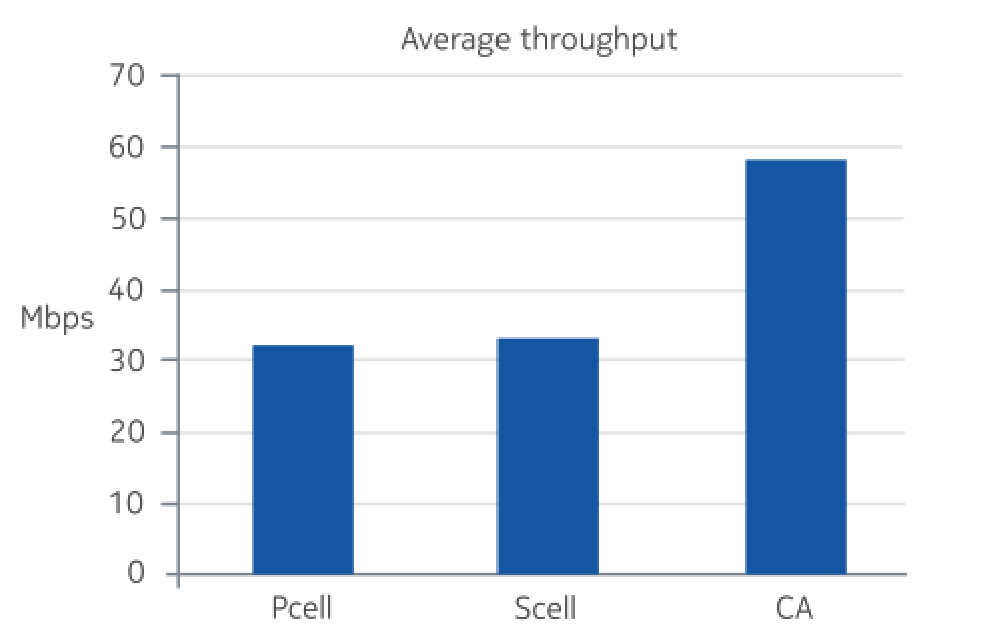
Carrier Aggregation (CA) works very well in real, live LTE networks. The reason is straightforward: when more spectrum is assigned to a single user connection, the phone can achieve higher peak speeds and better average data rates. For example, drive test results show that with a Cat 4 device using a single 10 MHz carrier, the data rate is about 30 Mbps. But when two 10 MHz carriers are combined (10 + 10 MHz CA), the average data rate doubles to around 60 Mbps. This clearly shows how CA boosts performance.
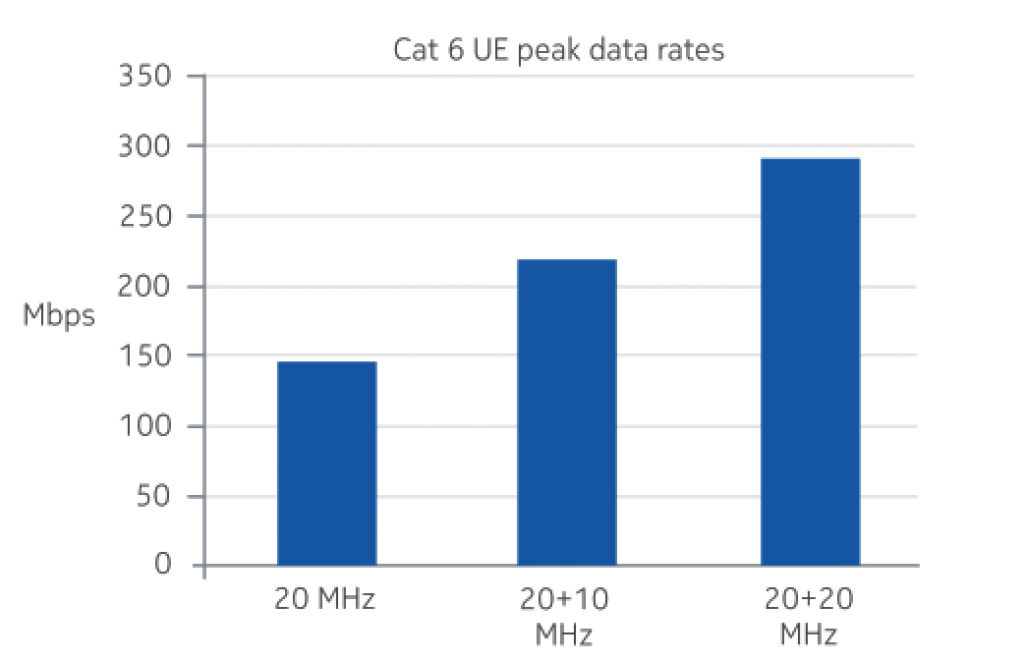
When using a Cat 6 device, the improvement is even greater. Peak speed tests show that combining 20 MHz + 10 MHz of spectrum can reach up to 225 Mbps, while combining 20 MHz + 20 MHz can reach up to 300 Mbps. This proves that the more spectrum you allocate through CA, the closer you get to the maximum capability of the device.
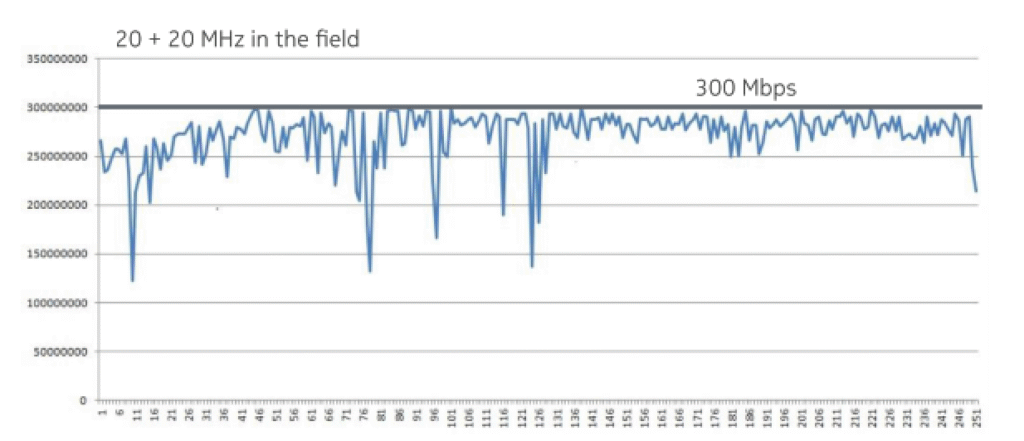
Field tests with a Cat 6 device also show that in good signal and low-interference conditions, real-world data rates between 250 and 300 Mbps are achievable. This demonstrates that Carrier Aggregation can deliver very high speeds in practical network environments when radio conditions are favorable.
Multi-band Traffic Management
Most operators began their LTE networks using only one frequency band in each area, such as 1800 MHz or 700 MHz. But as data demand increased, operators added more LTE bands—sometimes two or three in the same area. Today the number of bands continues to grow, which makes it more difficult to manage traffic across multiple frequencies. The goal of multi-band traffic management is to balance the load between bands and to use low-frequency bands efficiently because they provide wider coverage.
Carrier Aggregation (CA) makes this traffic management much easier. Without CA, networks must use handovers to move users between different frequencies. Handovers are relatively slow and take several seconds because the phone must measure the signal and then perform the handover procedure. Idle mode settings also need careful tuning. However, when CA is enabled, the network can balance the load quickly—within a few milliseconds—because the packet scheduler automatically decides how to distribute traffic across multiple carriers.
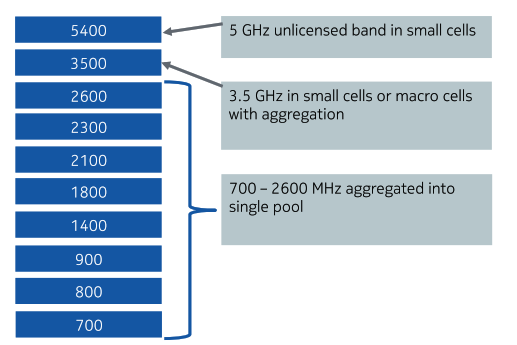
In Europe, operators commonly use frequency bands from 700 MHz to 2600 MHz, and these bands can be combined using CA to achieve fast and efficient traffic management. Even higher frequencies, such as 3.5 GHz, can be aggregated as long as there is a dense site network that provides enough coverage for those higher bands.
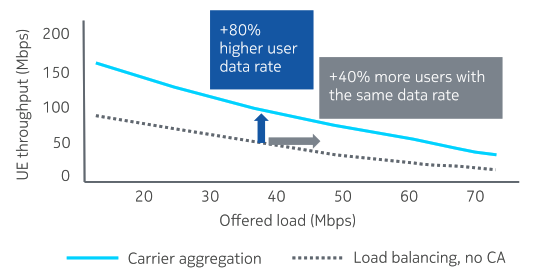
Carrier Aggregation (CA) provides a major advantage in load balancing, especially when the network becomes highly loaded. Figure 6 demonstrates this benefit by comparing user data rates with and without CA. When only a single 20 MHz carrier is used, the data rate follows the dotted curve, which assumes that load balancing is performed only at the start of each packet session. Under this condition, user throughput decreases quickly as system load increases. However, when 20 + 20 MHz carrier aggregation is activated and all devices support CA, the data rate follows the continuous curve. Because CA enables fast load balancing directly within the scheduler, the average user throughput increases significantly—by nearly 80%—even when the system is heavily loaded.
This improvement in efficiency means the operator can either deliver much higher data rates to users at the same load or serve more users at the same average throughput. In the illustrated example, the network can carry about 40% more load while still maintaining the same user experience. This highlights the operational value of CA not only for boosting peak data rates but also for enhancing overall capacity and stability in high-traffic conditions.
LTE networks contain both Carrier Aggregation (CA) devices and legacy non-CA devices, so the network must allocate resources fairly between them. Non-CA devices depend entirely on their Primary Cell (Pcell), which is often a low-band carrier with better coverage but limited bandwidth. CA devices, however, can use resources from both the Pcell and an additional Secondary Cell (Scell). To maintain fairness, Vendor Smart Scheduler allows the operator to assign more Pcell resources to non-CA devices because they do not have access to the Scell. In practice, this means a non-CA device may receive double the Pcell resources compared to a CA device, while the CA device compensates by receiving additional resources on the Scell. This ensures a more balanced user experience across different device capabilities.
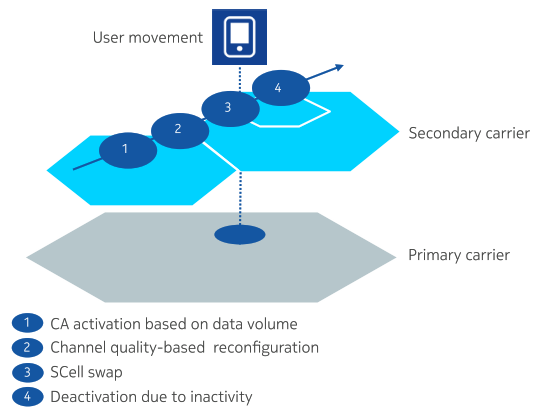
In practical network deployments, the Pcell and Scell may have different coverage areas due to variations in antenna placement, band frequencies, or antenna types. Because of this, the network must dynamically adjust the Scell assignment as the user moves. When the user’s data volume becomes high, the system activates carrier aggregation and adds an Scell. As the device moves, the Scell may no longer offer optimal coverage, so the scheduler reconfigures it to another suitable Scell that provides better signal conditions. This process may repeat multiple times as mobility continues. When the user becomes inactive or data demand drops, the system releases the Scell and deactivates CA to save network resources. This flexible Scell management ensures optimal throughput, stable performance, and efficient use of CA capabilities.
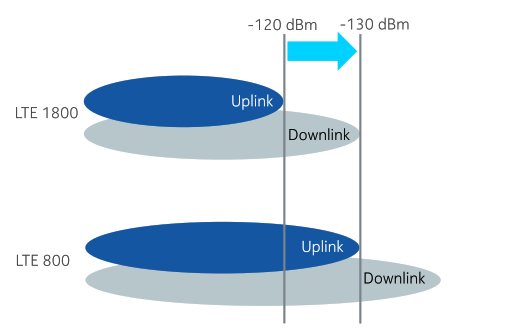
LTE coverage in macro cells is mainly limited by the uplink because mobile devices transmit at much lower power—around 200 mW—compared to a base station, which transmits tens of watts. In practice, LTE networks use a minimum RSRP threshold of about –120 dBm before handing the connection over to 3G. This threshold is defined by uplink limits, not downlink, because the downlink could technically reach even farther if uplink were not the constraint.
Coverage Benefits
Carrier Aggregation helps overcome this limitation by using the low-frequency band for the uplink, ensuring the device can still transmit even at weak signal levels. At the same time, the device can receive downlink data on both the low band and the high band. Without CA, the high band would not be usable in these edge coverage areas because the uplink would not reach.
As a result, CA effectively extends the usable downlink coverage of the high band. Field measurements show that high-band secondary cells (Scells) can still contribute to downlink throughput even at very low signal levels, down to –130 dBm. Meanwhile, users who are closer to the site can use the 1800 MHz band as the primary cell, benefiting from both enhanced uplink capability and higher-band downlink speeds.
FDD & TDD Aggregation
Carrier Aggregation originally focused on combining either two FDD carriers or two TDD carriers. This was the first phase of CA deployment, where networks aggregated only within the same duplex mode. The next step in the evolution was to allow FDD and TDD carriers to be aggregated together.
3GPP introduced support for FDD + TDD Carrier Aggregation in Release 12. This enhancement allows either FDD or TDD to act as the Primary Cell (Pcell). In early commercial implementations, the FDD band typically serves as the Pcell, while the TDD band is used as the Secondary Cell (Scell). These first deployments were expected to appear around 2015.
The combination of FDD and TDD in CA is especially attractive because it uses the strengths of both duplex modes. The low-band FDD carrier provides wide coverage and strong uplink performance, while the high-band TDD carrier contributes additional spectrum for higher data rates. This pairing helps operators maximize both coverage and capacity in real-world networks.
Carrier aggregation in Heterogeneous Networks
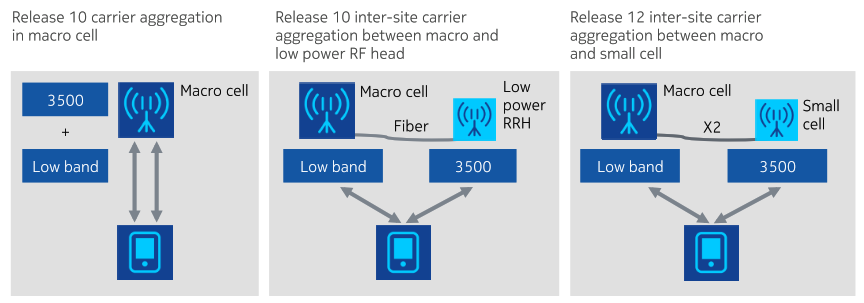
Carrier Aggregation also improves the value of small cell deployments in heterogeneous networks. Modern small cells already support high data rates of more than 200 Mbps using CA, making them an attractive option for boosting capacity in busy areas. In addition, CA can be activated between a macro cell and a low-power RF head when both are connected to the same macro baseband unit. This setup is supported in 3GPP Release 10, which requires that both the Primary Cell (Pcell) and Secondary Cell (Scell) be transmitted from the same baseband source.
3GPP Release 12 takes this concept further by enabling CA between two completely different base stations. This feature is known as inter-site carrier aggregation and is based on dual connectivity. In dual connectivity, the device maintains two simultaneous radio links—one to a macro cell and one to a small cell. This approach fits perfectly in heterogeneous networks, where macro cells operate on low bands for wide coverage, while small cells use higher bands to provide additional capacity and faster data rates.
In this configuration, the macro cell ensures stable mobility and coverage, while the small cell boosts speed and capacity when available. Communication between the macro and small cells is done over the X2 interface, which can also be supported by wireless backhaul links. This flexibility makes it easier for operators to deploy dense small-cell layers and still offer seamless, high-performance connectivity.
Aggregation with supplemental downlink
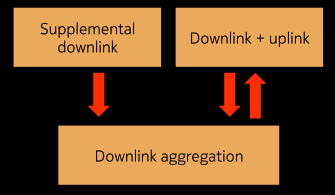
Carrier Aggregation also makes it possible to use special frequency bands that work only for the downlink. These are called supplemental downlink bands. 3GPP has defined two such bands Band 29 and Band 32. These bands do not support uplink transmission, but when combined with regular LTE bands through carrier aggregation, they can significantly boost downlink capacity and data rates.
This feature is especially useful because mobile broadband traffic is highly unbalanced. In most networks, downlink traffic is about ten times higher than uplink traffic. Users download far more data than they upload—such as videos, webpages, and app content. Supplemental downlink bands help operators match this real traffic pattern by adding more downlink resources without needing extra uplink spectrum.
By combining supplemental downlink bands with the main LTE band using carrier aggregation, operators can improve user experience, increase network capacity, and efficiently use available spectrum.
Device Power Consumption Optimization
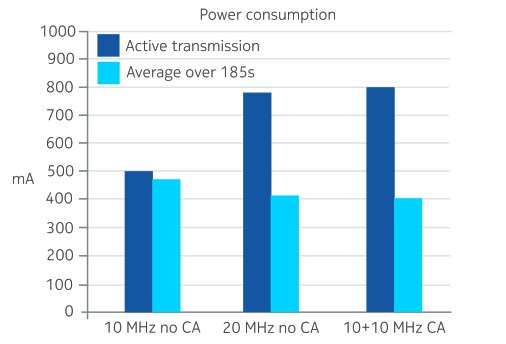
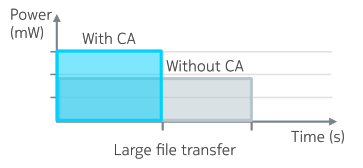
Carrier aggregation can affect a smartphone’s battery life because the device needs to monitor two frequency bands at the same time. It also activates extra radio hardware and increases the activity of the baseband processor. During large data transfers, such as downloading a file, this increases power consumption temporarily.
However, the higher data rates provided by carrier aggregation make downloads faster. As a result, the device can return to a low-power idle state sooner, which improves overall energy efficiency and can actually save battery life over the full duration of the activity. In tests, devices using carrier aggregation for a full download period of 185 seconds consumed less average power than those using a single carrier.
On the other hand, carrier aggregation increases power usage if it is activated even when no significant data is being transferred. This is because the device must continuously monitor two frequencies. For small or background data transfers, this can increase power consumption by up to 80% compared with a single carrier setup.
The key takeaway is that carrier aggregation is most beneficial when transferring large amounts of data. For small or background transfers, it is better to avoid using carrier aggregation to save battery life.
Aggregation with unlicensed frequencies
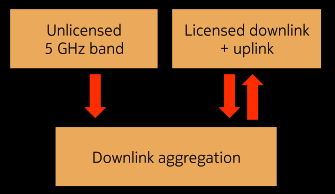
LTE can also use unlicensed spectrum, such as the 5 GHz band, to increase network capacity and data rates. This approach is defined in 3GPP Release 13 and is called LTE for Unlicensed (LTE-U) or Licensed Assisted Access (LAA). It works by aggregating the operator’s licensed frequencies with the unlicensed band.
The idea builds on the concept of supplemental downlink. The licensed band provides a stable connection for both uplink and downlink, while the unlicensed band boosts user data rates. The downlink data can be split between these two bands based on device reports (CQI) and the traffic load on each band.
For the first time, LTE-U allows a single technology to use both licensed and unlicensed bands and perform fast load balancing between them. Studies show that LTE-U with advanced LTE features can double spectral efficiency and increase cell range compared to Wi-Fi operating on the same band. LTE-U is designed to coexist smoothly with Wi-Fi networks on the same spectrum.
Evolution of Carrier Aggregation
Carrier aggregation continues to evolve in LTE networks. Initially, 3GPP Release 10 supported up to five component carriers, and Release 12 extended signaling capabilities to handle even more carriers. Many operators now have over 100 MHz of spectrum available for LTE, and improvements in device baseband and radio hardware make it possible to achieve higher data rates.
Nokia demonstrated a data rate of 4 Gbps by aggregating ten carriers along with MIMO technology. Both FDD and TDD frequencies were used in this demonstration, which relied on commercial Flexi Multiradio 10 base station equipment. So far, carrier aggregation has mainly focused on the downlink, but uplink aggregation with two component carriers is expected soon to better match growing downlink speeds.
In summary, carrier aggregation is a key feature of LTE-Advanced because it increases practical data rates, improves network capacity, simplifies traffic management, and extends coverage. Commercial deployments started in 2013, with peak data rates reaching 300 Mbps in 2014 and expected to reach 450 Mbps in 2015. Carrier aggregation performs robustly in live networks, can combine both FDD and TDD frequencies, and even mix licensed and unlicensed spectrum. Advanced schedulers, like Nokia Smart Scheduler, maximize the benefits of carrier aggregation by fairly distributing resources between devices while minimizing battery consumption.