


Standardized Rules for Measurement on Rotating Machinery
Introduction
In order to better understand the behavior or rotating machinery, it is most desirable to standardize communication by means of a set of recommended practices defining the polarity and phase referencing of transducers, data storage and data presentation techniques.
This set of transducer orientation and polarity recommendations has been informally developed by machinery engineers and gradually standardized by Bently Nevada Corporation for its customers’ convenience. These recommendations are formulated to remove various possible ambiguities and are fully independent of the direction of rotation, dynamic impedance and dynamic action of the machine.
Non-contacting Relative Displacement
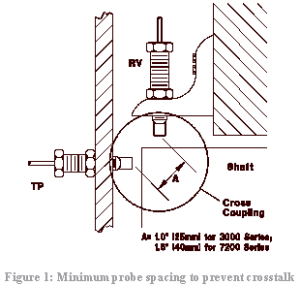
Motion toward the transducer along its sensitive axis shall produce a positive (+) magnitude of voltage or current. The polarity of a relative displacement transducer such as the Bently Nevada proximity probe is easily tested by decreasing gap as shown in Figure 1. The gap can be decreased by either moving the probe towards the observed material, or by moving the observed material towards the probe. Use of a Bently Nevada TK 3 is highly recommended.

Inertially referenced Displacement, Velocity and Acceleration
The polarity of Inertially referenced displacement, velocity or accelerometer transducers is easily tested by means of a tap test. The tap test consists of lightly tapping the transducer in its sensitive axis. The resulting timebase waveform, as shown in Figure 2, is an initially positive (+) going output signal when tapped toward the sensitive axis.