What is Sulfide Stress Cracking (SSC)?
Sulfide Stress Cracking (SSC) is a type of corrosion cracking that can occur in susceptible materials exposed to a sulfide-containing environment, typically in industries…
Read articleBrowse 748 free articles, standards and practical guides about PakTechPoint.
748 articles in this topic
Sulfide Stress Cracking (SSC) is a type of corrosion cracking that can occur in susceptible materials exposed to a sulfide-containing environment, typically in industries…
Read articleHydrogen Induced Cracking (HIC) is a form of material degradation that occurs in carbon and low-alloy steels exposed to hydrogen-containing environments, typically in the presence of…
Read articleThis article is to guide the responsible persons in conducting Distance or Impedance Protection Relay (21) Commissioning and test. Testing and commissioning a distance…
Read articleThis article is to guide the responsible persons in conducting Restricted Earth Fault Protection stability & sensitivity test. Testing restricted earth fault (REF) protection…
Read articleThis article is to guide the responsible persons in conducting Overvoltage and Under Voltage Relay (59/27) Test procedure. Testing overvoltage (59) and undervoltage (27)…
Read articleTesting directional overcurrent and earth fault protection relays (67/67N) involves several steps to ensure their proper functioning. This article is to guide the responsible…
Read articleTesting the Directional Negative Phase Sequence Overcurrent Relay (67Q) is essential to ensure its reliable operation in detecting and protecting against negative sequence overcurrent…
Read articleTesting the stability and sensitivity of Reactor Differential Protection (87R) is crucial to ensure that the protection scheme operates reliably under various operating conditions…
Read articleThis article is to guide the responsible persons in conducting Reactor Differential Protection relay (87R) Commissioning and Testing. Commissioning and testing the Reactor Differential…
Read articleIn electrical engineering, a reactor refers to a passive two-terminal electrical component that introduces inductance into a circuit. It is primarily used to control…
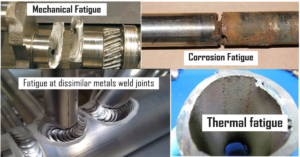
Read articleThere are two main forms of fatigue on the metals, the mechanical fatigue and the thermal fatigues. Both of these fatigues result in weakening and failure of the metals at the localized areas which undergo the metallurgical changes due to applied cyclical stresses well below the plastic deformation stress values, for specified period of time. Most vulnerable are the unsupported small bore piping attached to the system containing pumps and compressors which induce the cyclic stress on the adjacent structures. The anchoring points of the lines which shake due to liquid hammering and frequent rapid flow like relief piping are also affected by fatigue. Since all forms of fatigues are the metallurgical changes, the earlier detection of the fatigue is possible by the Eddy Current and electrical resistance measurement methods. 1. Mechanical Fatigue. Metals subjected to a repetitive dynamic loading for a certain period of time fail at a stress level much lower than that required to cause fracture on a single application of load. Such failures occurring under conditions of dynamic loading are called fatigue failures. The period after which the failure occurs varies and depends of the alloy composition. Theductile metals usually require higher number of loading before failure called as higher endurance. A fatigue failure is particularly dangerous because it occurs without any obvious warning. Fatigue results in a brittle‐appearing fracture, with no gross deformation at …
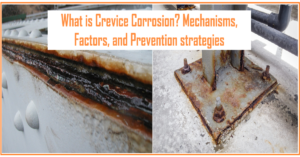
Read articleCrevice corrosion is a type of localized corrosion that occurs in narrow gaps or crevices between metal surfaces. Despite its deceptive appearance, crevice corrosion…
Read article